
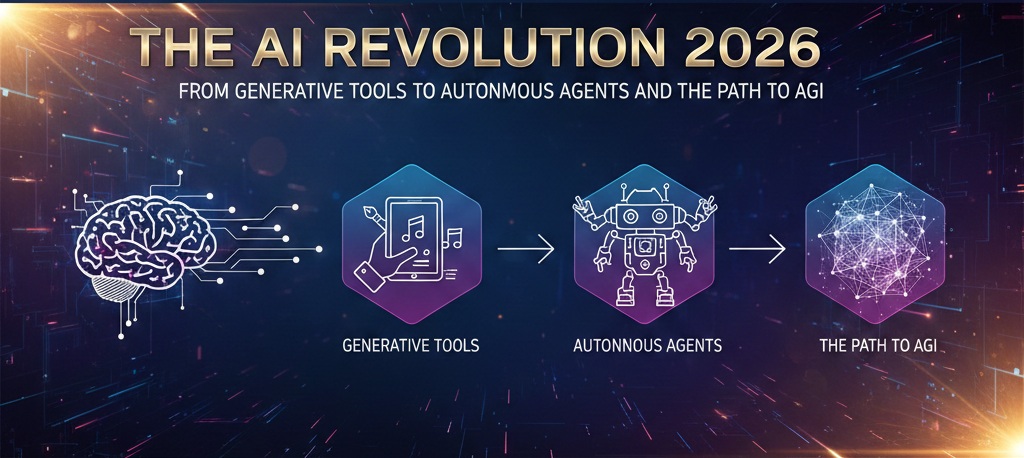
In the history of human civilization, it would not be an exaggeration to say that there are no transformative eras like the artificial intelligence revolution of 2026 that we are currently living through. As we move from 2025 into 2026, artificial intelligence has transformed from a digital novelty into a fundamental part of our global infrastructure.
1. Introduction: The Dawn of a New Reality
Did you know? We are all living in an era where the boundaries between imagination and reality have finally broken down. Just three years ago, creating a high-definition (HD, 4K) video or image from a simple text prompt seemed like magic. In 2026, it has become a standard workflow for creators worldwide.
AI is no longer just a “chatbot” that you simply talk to; it has now become an autonomous agent that thinks, plans, and implements. Whether managing global supply chains or diagnosing rare diseases, AI has become a cognitive partner, proving this day after day. This post explores the current landscape of AI in 2026, debunks myths surrounding the job market, and provides a roadmap for a future where human-AI collaboration will be the ultimate superpower.
2. The AI Revolution 2026 Landscape: Beyond the Hype
The transformation from “generative AI” in 2023 to “agentic AI” in 2026 is extremely frightening for us. This is where we stand today:
From Conversation to Action (Autonomous Agents)
Earlier versions of AI required continuous commands. But today, we use AI agents. These have evolved into systems that don’t just write an email; they research the recipient, check your calendar, and schedule meetings. They also update your CRM without you having to lift a finger.
Multimodal Supremacy
By 2026, AI will no longer be “blind.” It will process text, audio, HD photos, 4K videos, and sensory data simultaneously in real time. This multi-modal Artificial Intelligence (AI) will allow it to “see” the procedure for surgeons in the Operating Room (OR) or help visually impaired individuals navigate complex urban environments with incredible accuracy.
The AGI Horizon
While we haven’t fully achieved Artificial General Intelligence (AGI)—the point where AI equals or surpasses human intelligence across all tasks—we are in the “Proto-AGI” stage. Systems now exhibit reasoning capabilities that allow them to solve math and coding problems they weren’t specifically trained for.
3. The Job Market Myth: Displacement vs. Evolution
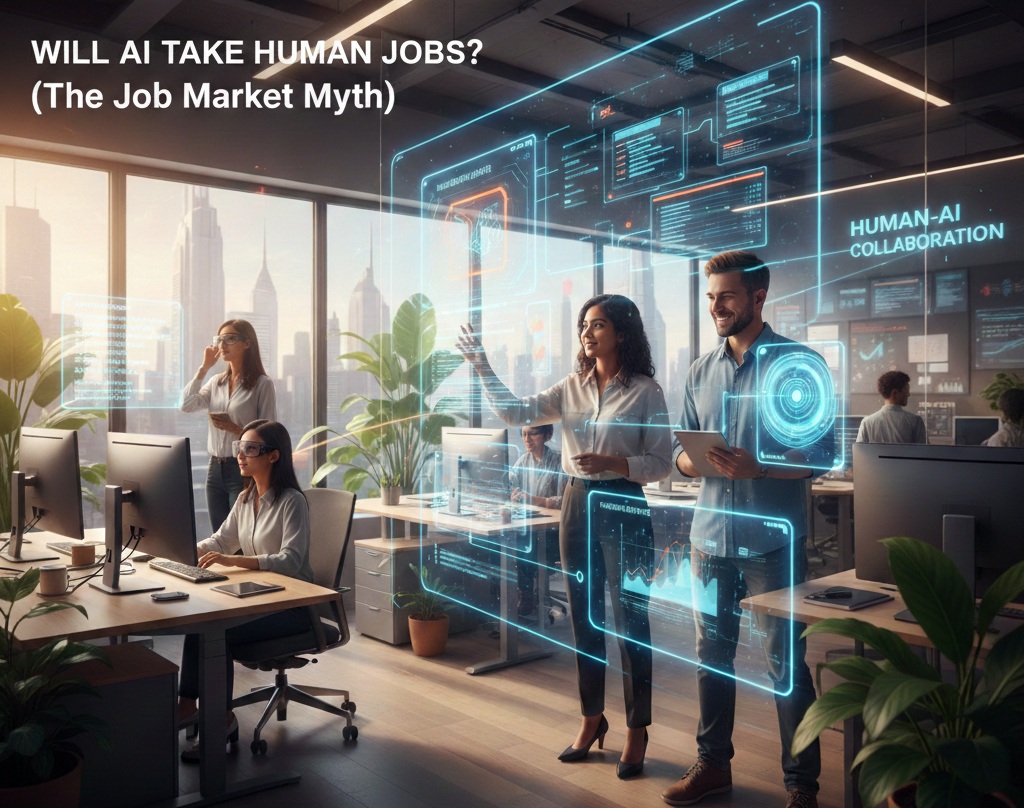
The most frequent question asked by international readers is: “Will AI take my job?” The short answer is no, but “A human using AI will replace a human who isn’t.”
The Shift in Expertise
Historically, technology has always shifted the labor market. In 2026, we are seeing the rise of:
- AI Orchestrators: Professionals who manage fleets of AI agents to complete complex projects.
- Ethics & Bias Auditors: Specialists who ensure AI decisions are fair and transparent.
- Data Curators: Humans who oversee the quality of “synthetic data” used to train next-gen models.
Productivity Explosion
Data shows that software engineers and content creators using AI are now 5x to 10x more productive than they were in 2023. AI handles the “grunt work”—debugging, formatting, and basic research—leaving the human to focus on Strategy, Creativity, and Empathy—traits that AI still cannot replicate.
Key Takeaway: The danger isn’t the AI; it’s the refusal to adapt. The 2026 economy rewards those who treat this AI Revolution 2026 as a ‘Co-Pilot’ rather than a competitor.
4. Practical Use Cases: Impacting Daily Lives
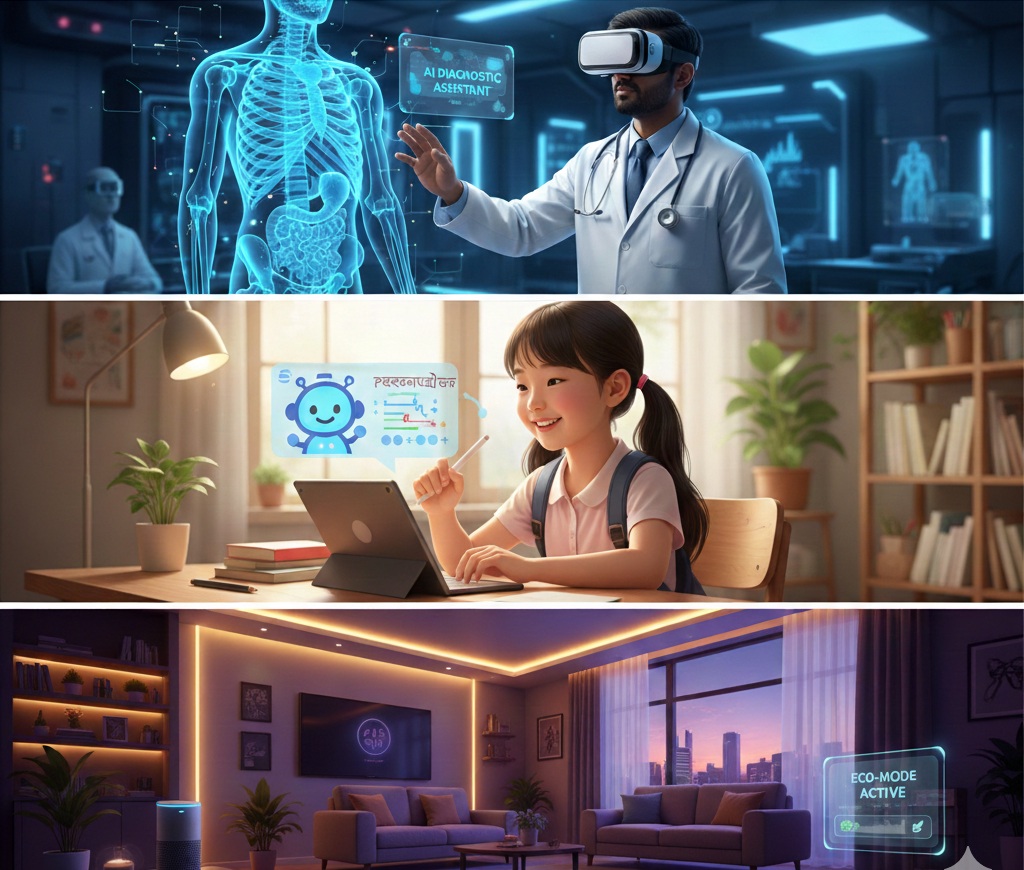
How is this technology actually changing the world for a person living in New York, London, or Dhaka?
Hyper-Personalized Healthcare
Wearables in 2026 do more than count steps. They use predictive AI to detect early signs of cardiovascular issues or hormonal imbalances weeks before symptoms appear. AI-driven drug discovery has also reduced the time to create life-saving vaccines from years to mere months.
The Education Revolution
The “one-size-fits-all” education system is dead. AI tutors now provide a bespoke curriculum for every student. If a child learns better through visual storytelling than text, the AI adapts the entire physics lesson into an interactive VR experience in real-time.
Smart Infrastructure and Sustainability
AI-driven “Smart Grids” are now the backbone of green energy. By predicting weather patterns and energy consumption, AI optimizes power distribution, significantly reducing global carbon footprints and helping nations meet their 2030 climate goals.
5. Ethics, Security, and the “Dark Side”

With great power comes unprecedented risk. With the rise of the AI Revolution 2026, we must also address the shadows of this transformation.
- The Deepfake Crisis: In 2026, distinguishing between a real video call and a synthesized one is nearly impossible without “Digital Watermarking.” This poses a threat to political stability and personal security.
- Data Sovereignty: Who owns your data? As AI models require more personal information to be “helpful,” the debate over privacy vs. utility has reached a boiling point.
- Algorithmic Bias: If an AI is trained on biased data, it will produce biased results. Ensuring “Fairness in AI” is no longer just a technical challenge; it’s a human rights necessity.
6. The Roadmap Ahead: Human-AI Symbiosis
What does the next decade look like?
Quantum AI
The integration of Quantum Computing with AI is expected to accelerate processing speeds by a factor of millions. This will allow us to simulate complex molecular structures, potentially curing diseases like Alzheimer’s or solving the secret to infinite clean energy (Nuclear Fusion).
Neural Interfaces
We are moving toward a world where the “keyboard” becomes obsolete. Startups are already testing non-invasive neural links that allow humans to communicate with AI through thought, potentially merging human intuition with machine calculation.
7. Conclusion: Embracing the Superpower
AI is not a storm to be weathered; it is a wind to be harnessed. AI Revolution 2026, the divide between the “haves” and “have-nots” will be defined by AI Literacy.
Whether you are a student, a CEO, or a creative, this technology offers you a superpower—the ability to amplify your human potential. The future doesn’t belong to the machines; it belongs to the humans who learn to lead them.
Stay tuned to NexlyZone as we continue to track every pulse of this digital transformation. The revolution has just begun.